
Monthly Plan & Checklist for a Craft Business
To make money and run a profitable business… you must be organized.
Let’s stop treating our businesses like a hobby and flying by the seat of our pants.
Instead, let’s take a hard look at our numbers, what we need to make in revenue and profit to be able to call our operations a successful business and determine what it will take to get there this month.
This is a general guide for a handmade business, BUT it absolutely requires your expertise.
Depending on the type of business you run, the products you make and the schedule you follow, you may be able to use all of the ideas mentioned here, some, or none of them.
No one (myself included) can give you be-all and end-all advice to run your business. Use articles like this to inspire and guide you, but apply your expertise and knowledge to make the ideas work for you.
If you want a more detailed planner with more guidance, check out: The Success Planner for your Handmade Business
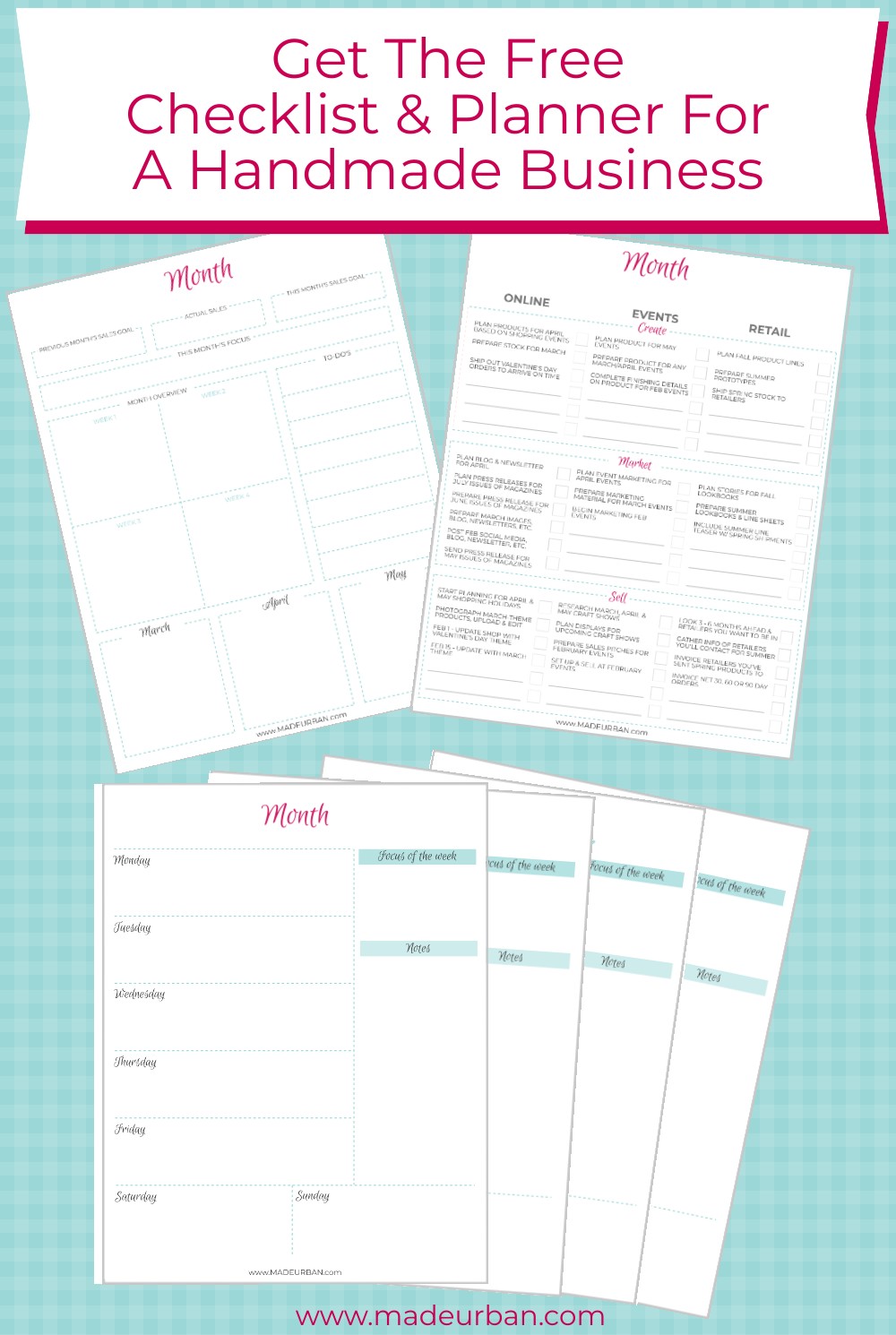
>> Download the free checklist and worksheets here
1) Goals & Plans
You should already have a sales goal you’d like to hit for the year. If you don’t, set that goal now and roughly distribute it between the 12 months, giving a higher goal for busy months and a lower goal for slower months.
For example, if you’d like to earn $15,000 for the year, you’d divide that by 12 to have a goal of $1250 each month. But you may sell jewelry and know January is a slow month, February is busy, and March falls in between. So you might set your sales goal to $800 for January, make up that $450 in February with a $1700 goal and $1250 for March.
Use the printable worksheets to:
- Write down last month’s sales goal
- Write down what your actual sales were for last month– Did you hit your goal? Exceed it? Come in under? Adjust your future goals accordingly. For example, if you were $200 under your goal, you may tack that $200 on to your February goal to stay on track for your yearly goal. Or that $200 may be distributed evenly among the next 11 months, adding $18 onto each month’s goal.
- Write down your sales goal for the upcoming month
- Write down your main focus for the upcoming month – For example, if next month is February and Valentine’s Day is a holiday that generates a lot of sales for your business, “Valentine’s Day sales” might be your focus. If February is a slow month for you because you sell summer products, planning and prepping summer product lines may be your focus this month. List one or two areas of business that will get your main focus in February.
- Write down your focus for each week of the upcoming month – For example, if the upcoming month is February, look at February by week 1, 2, 3 and 4. What are the important tasks, events, dates, etc. of each week? You don’t need to get into details, simply write the big events for each week. For example: Week 1 – Valentine’s Day marketing | Week 2 – Valentine’s Day & craft show | Week 3 – Update online shops & social media to March theme | Week 4 – Run promotion to clear out Valentine’s Day stock
- Write down important to-dos for the upcoming month – List any important tasks that must be completed this month. Again, don’t get into details, simply jot down anything you must remember (e.g. application deadline for Mother’s Day craft show).
- Write down important dates for the following months – Look at least 3 months ahead to see what’s coming up and what impacts your plan and prepare tasks. For example, if the upcoming month is February, take a look ahead to March, April, and May. You don’t want to go into March without a plan for St. Patrick’s Day, the first day of Spring, or any other events relevant to your business.List important events, holidays, deadlines, etc. for March, April and May.
2) Business Stages
To help stay organized, I’ve found it helpful to look at business as three main areas:
- Create
- Market
- Sell
First, you must create a product, then you must market that product so people are aware of it, and then you must sell that product.
Each area (create, market & sell) requires your attention each month.
The tasks that fall under each area will depend on the sales channel(s) you use. Here I’ll cover the main channels handmade businesses use:
- Online (e.g. your website or Etsy shop)
- Events (e.g. craft shows, farmers’ markets, etc.)
- Retail (e.g. selling wholesale to shops & boutiques)
To ensure I’m not just focusing on tasks that need my immediate attention, I like to break tasks into:
- Plan – looking 3+ months in advance, these are tasks that require thought, but not a lot of action just yet. For example, in February, I may start thinking about products I’d like to launch for summer. That may involve, roughly outlining how many collections I’d like, color schemes, etc.
- Prepare – looking 1+ month(s) in advance, these are tasks that must be completed for next month. Working on them now ensures I’m prepared and staying ahead of schedule. For example, in February, I would work on preparing stock for an Easter or Mother’s Day craft show.
- Present – looking at the current month, these are tasks that must be completed this month. For example, in February, I would present my Valentine’s Day-themed products at a Valentine’s Day craft show.
Take a look at the sales channel(s) you use and read my suggestions for tasks you could work on in February when it comes to planning, preparing and presenting: creating tasks, marketing tasks and selling tasks.
Examples
In the following examples, we’ll imagine the upcoming month is February.
ONLINE
- SELL
- Plan – Look ahead 2 – 3 months and determine what type of online shopping events are coming up. April and May are Spring months, and you may want to update your online shop to a Spring theme. You may also consider: April – Easter, April Fool’s, etc. May – Mother’s Day, start of wedding season, etc. Or search holidays related to your products. For example, April 11 is National Pet Day – good for pet-related businesses. April 22 is Earth Day – important for environmentally friendly products/businesses. Plan what it means for your shop to implement a spring theme or holiday. Do you need to update your banner, props in your photos, or run a promotion?
- Prepare – Photo shoots for March-themed products should be scheduled this month. Photos should be edited and uploaded so you’re ready to create listings and update your banner once Valentine’s Day is over.
- Present – At the beginning of February, your shop should be updated with a Valentine’s Day theme, if it’s a fit for your products and business. The banner or home page image can get a refresh, shop announcements may be updated with order deadlines to receive shipments in time for Valentine’s Day, promotions you’re running, listings updated with Valentine’s Day images, titles, tags, etc. After February 14th, Valentine’s Day products should be cleared out so your online shop doesn’t look outdated. You may run a promotion and mark down stock or simply update photos and listings to turn products back to no theme, instead of Valentine’s-day themed.
- MARKET
- Plan – Start planning marketing for April, based on the marketing channels and methods you currently use. For example, plan your newsletter schedule and topics. Look ahead several months if you plan to send press releases. Magazines operate similarly to retailers, several months in advance. Download the media kits of magazines you’d love to be featured in and get an idea of when deadlines are for advertising. Although you’re hoping to be featured, not advertised, it gives you an idea of when they hope to have an issue of a magazine drafted.
- Prepare – Prepare marketing for March. If you’re running ads, prepare the text and images so they’re ready to go. For any social media platforms that allow you to schedule posts in advance, do so. Do you need to prepare any images or text for social media marketing? Do you need to draft blog posts? If you rely on the press for marketing, start drafting press releases for June issues so they’re ready to be sent in March.
- Present – You should be marketing your Valentine’s Day products by posting Valentine’s Day-related social media posts, blog articles, sending newsletters, etc. Press releases should be sent if you hope to appear in a May issue of a magazine as closing dates are generally end of February.
- CREATE
- Plan – Look ahead to April and May and start thinking about new products you may want to introduce based on holidays or shopping events. For example, Easter or Mother’s Day-themed products.
- Prepare – Begin creating stock for March so it’s ready for orders next month. Purchase materials at the beginning of the month and begin production.
- Present – Tagging and packaging Valentine’s Day-themed products and February stock so it’s ready to be shipped. Prototypes for March products should be completed so they can be photographed and photos can be uploaded and edited in time to update your shop at the end of February or beginning of March.
CRAFT SHOWS
- SELL
- Plan – Look ahead at least 1 – 3 months to be aware of upcoming events you’d like to participate in and mark the application deadlines in your calendar. It’s also never too early to start thinking about how you might create an attractive display. Event organizers love to hear you’re putting thought into it.
- Prepare – If you have events scheduled for March, April or May, you should be working on your display and gathering props, display fixtures, signage, etc.
- Present – If you’re participating in a February craft show, you’ll be setting up your display and selling on those allotted days. Be sure all display props are gathered and ready to go. You should also have your sales pitches determined (if selling doesn’t come naturally to you)
- MARKET
- Plan – If you have craft shows in April, plan when and how you’ll market the event to your fans, followers and existing customers. You may roughly mark the week marketing will begin through social media, newsletters, etc. plan when to start sending mailers or handing out flyers, etc.
- Prepare – Marketing materials should be prepared this month for any events in March. You’ll need flyers, images to share on social media, newsletter(s) draft(s), etc.
- Present – If you’re participating in February craft shows, your marketing can begin now. Start posting to social media, encouraging people to mark the date in their calendar and post reminders in the days leading up to the event. Mailers to existing (local) customers should be sent and flyers for the event should be handed out. A newsletter should be sent this month, the week of the event, to encourage local customers to show up. Give them an incentive to shop with you at the event, instead of online (e.g. special discount if they print a coupon you share, new products available at the event only, etc.).
- CREATE
- Plan – Start thinking about and researching products for May events or even summer ones you plan to participate in.
- Prepare – If you’re participating in March or April craft shows, work on building stock.
- Present – If you’re participating in February craft shows, stock should be completed. Work on finishing details for that stock: tagging, packaging, pricing and packing into containers for transport.
RETAIL
- SELL
- Plan – Look ahead 3 – 6 months as that’s generally the schedule retailers follow. In February, most retailers start to shop for summer product. So when it comes to planning, you should be thinking about fall already. Most handmade businesses will be working with smaller retailers and boutiques, who tend not to buy stock quite as far in advance as big retailers, but this is still a good month to start thinking about fall, the retailers you would like your products in and how you would like to expand the retail side of your business in 3 – 6 months.
- Prepare – Gather names, emails, mailing addresses, etc. of retailers you want to pitch your summer products to.
- Present – If you’ve sold spring products to retailers, you’re likely shipping orders to retailers this month, which means you’ll need to prepare and send invoices based on the terms you agreed to.Some retailers will want to pay net 30, 60 or 90, meaning they pay their invoice 30, 60 or 90 days after they receive your product. If you sell wholesale with these terms, you’ll need to invoice retailers you sent product to in January with net 30 terms, December with net 60 terms, or November with net 90 terms.
- MARKET
- Plan – Start thinking about how you will market your fall product line to retailers and which retailers you will market to. What will be the theme of your lookbook? What type of photoshoots will you need to plan for it?
- Prepare – Summer lookbooks and line sheets should be prepared by the end of February so they’re ready to be sent out at the beginning of March.
- Present – Generally, spring product is arriving at retailers, so you can use this opportunity to market your summer line. You likely won’t have prototypes, lookbooks, line sheets, etc. prepared but consider including a postcard that reminds retailers your summer line is coming up and to keep an eye out for your lookbook in a month or two.
- CREATE
- Plan – Begin brainstorming fall product lines as retailers buy 3 – 6 months in advance. Research upcoming trends, start getting an idea of materials you’ll use, etc.
- Prepare – Start working on summer product lines; buying materials, creating prototypes, pricing, etc. so product is ready to be photographed and lookbooks and line sheets can be created by the end of the month.
- Present – Each retailer will specify when they want orders shipped but generally, spring product orders should be filled and shipped this month.
3) Schedule
Use the last page of the worksheet to schedule your tasks for each week.
Print one sheet for each week of the month.
Be sure you’re adding “tasks” to each day…and not projects. Meaning, only schedule what you can get done within your workday.
Adding big items to your schedule can make you feel overwhelmed and upset if you don’t complete them.
As mentioned, be sure you’re not blindly following the plan, and you’re adjusting it to fit your business.
This article does not cover any operational tasks, such as paying bills, filing taxes, answering emails, etc. Please be sure to mark any important operational tasks on your calendar as well.
>> Download the free printable worksheets here

Hey, I’m Erin 🙂 I write about small business and craft show techniques I’ve learned from being a small business owner for almost 2 decades, selling at dozens of craft shows, and earning a diploma in Visual Communication Design. I hope you find my advice helpful!
Have been reading and following your tips and advice for several weeks now.
Have been working on a new Shabby Chic line of practical items, not just
frou frou shelf sitters. I am giving this line one year to succeed. If it does not go over in this southwestern little mountain community I will use it in my own living room and sewing room as they are already Shabby chic and have been for over 20 years LOL I just didn’t know it at the time I put together this look.
I appreciate all the good advice you have given us and will let you know if this
season is better than last and try to analyze why it is so I can continue to be successful. Thank goodness Hubby and I do not have to make a living at this. We are retired and doing it for fun, and a way to stay brain active.
Thank you so much for this post! It is awesome to see it written out this way, so precise and easy to follow. This will help me get more organized and boy do I need that!
Such detail is so appreciated!
Erin; Thanks for another great update on organization. I hope to approach some retail businesses for my Garden Artwork. I thought of a new aspect to make it different from others in the market place.
I am getting positive feedback from my newsletter. Joyce
wowwwww Thank you so much I really appreciate all the good advice you have given. Sometimes we need to recognize the simple true in life,
and that is THERE IS ANGELS AMONG US, people who love to help others, and are there quiet helping, Made Urban THANK YOU so much!!!