
Product Descriptions that Sell: 3 Answers you Must Know
In the first part of “Product Descriptions that Sell,” I explained the 2 main reasons people buy. If your products and their descriptions don’t appeal to at least one of those two reasons, you’re going to have a hard time making sales.
Head over and read that article first if you haven’t already. And download the free printable product description worksheets if you’d like:
In the second part of this series, I want to explain 3 questions you must answer before you start writing product descriptions.
Product Descriptions Question #1 – Who are you talking to?
I know you’ve heard it before; define your ideal customer and talk to them and only them.
Imagine I told you to sell your handmade product to a teenager.
What would you say?
Which words would you use?
What would the tone of your description be?
What type of features would you point out?
Now, describe that same handmade product to someone in their 40’s.
Would you use different words, a different tone, or point out different product features?
Who you’re selling to makes a big difference when it comes to your descriptions and impacts the following elements.
A) Keywords
The most important aspect of knowing who you’re talking to is to know what they’re searching for.
If I make a messenger bag, but people come across my product listing when they search “laptop bag”, that’s important information to know. I would change the name of my bag and the entire product description to appeal to someone who’s going to use the bag specifically to carry their laptop.
Which keywords do shoppers enter into a search bar to find your product?
Google Analytics
If you have a website, Google Analytics and Google Search Console will help you find the keywords your target market is searching when they discover your website.
Once you uncover those keywords, you can use them in your product’s title and description to increase the chances of your product listing showing up in popular searches.
If you don’t have stats to work off, take advantage of the information Google shares.
Search Phrases
Type your product name into Google’s search bar and get an idea of what people specifically search for when it comes to your handmade product.
Check out the other search phrases that load below the search bar, or scroll to the bottom of the page, where you’ll find a list of popular search phrases.
For example, if I type “handmade laptop bag” into the Google search bar, these are the related search phrases that load.
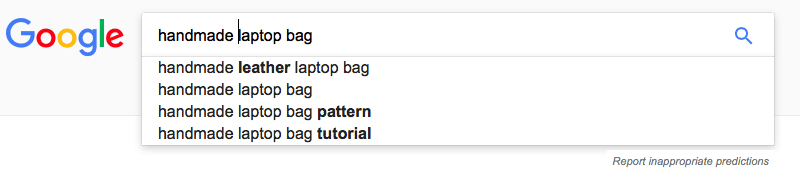
If I hit enter and go to the bottom of the page, the following related search phrases are shown.
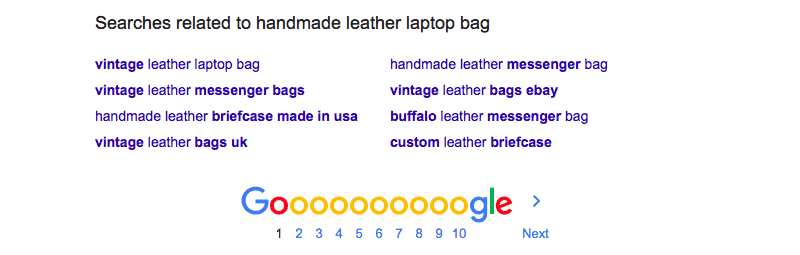
I may consider adding “messenger” into my title (Handmade Messenger Laptop Bag) since “messenger” is a popular keyword searched with “handmade laptop bag”. In my descriptions, I could also use “messenger” to describe my bag style or how to wear it instead of “cross-body” or “long strap”.
I may also consider offering leather laptop bags or making my bags out of vintage material since “leather” and “vintage” are often searched with “handmade laptop bag”. A small change could really increase my chances of being found in searches, which could lead to more sales.
Don’t expect Google to change their search result algorithm or shoppers to start searching different terms based on your product. You must adapt to them.
Keyword Tool
There are many keyword tools out there that will tell you the popular longtail keyword phrases people search.
You start with your product name (e.g. “laptop bag” or “messenger bag”) and the keyword tool will show you the words most commonly searched with that term.
There are many different tools to choose from and the way they work can change over time, so I won’t go into the steps for conducting keyword research here. Just know those tools do exist if you want to dive deeper into keyword research.
B) The tone of your descriptions
Pretend you’re having a conversation with someone you know; a good friend or family member.
How would you describe your handmade product to them?
That’s the way you should write your product description.
Don’t think in terms of the information you need to get in; that’s how product descriptions become lacklustre.
Think about your ideal customer and how you would speak to them about your product to get them excited about it.
Share your enthusiasm, your story, your passion; not a fact sheet.
If I were talking about my laptop bag to someone, which I designed with a sophisticated working woman in mind, I wouldn’t say “Green laptop bag. Handmade. 12 inches by 16 inches.” I’d be a little more descriptive in my conversation and sound less like a robot.
And I also wouldn’t use words like “awesome” or “so cool”. That wouldn’t be consistent with the sophisticated vibe I want my bags to give off.
Keep your description interesting and in line with your product and brand.
C) Product benefits
I’m going to explain product benefits in more detail, but when you know who you’re talking to, it will help you point out the benefits that are important to them in product descriptions.
A teenager is going to care about much different benefits than someone in their 40’s will. Holding that person in mind will ensure you share information in your description that holds their attention and helps you make a sale.

Product Descriptions Question #2 – What do you want your customer to feel?
Descriptions should have a purpose when it comes to feeling. Do you feel anything when you read: “Green laptop bag. Handmade. 12 inches x 16 inches.”
Do you feel a connection to the bag, the maker or the brand?
What type of person would that bag be perfect for?
Someone whose style is bold and quirky, classic and sophisticated or somewhere in between?
I certainly can’t tell from the description.
Create an experience for your shopper! Get them excited and feeling something. One photo and one line of text are not enough.
The work you completed in the first part of this series will come into play here. (Product Descriptions that Sell Part 1)
What did you determine was the main emotion driving your purchases? Are your customers trying to avoid a negative feeling or gain a positive one?
Once you know that, you can get more specific.
Which specific negative or positive emotion do you want to evoke?
>> If it’s a pain you’re helping them avoid, what type of pain? Frustration, embarrassment, stress, etc.?
>> If it’s a pleasure, what type of positive emotion do you want your customers to feel? Calm, excited, confident, etc.?
Once you define the exact emotion, decide on the keywords you can use to evoke it.
Use those words throughout your description to describe your handmade product or to paint a picture.
For example, if a soap vendor chooses the word “calm” as the positive emotion they want to evoke, “relax”, “unwind”, “serene” or “soothing” are words they can use to describe their handmade bath bombs or to paint the picture of a stress-free bath time.
“When you’re stressed out and ready for some R&R, light some candles, grab a glass of your favorite wine, draw a bath and drop this soothing bath bomb in. The lavender scent will calm your senses while the Epsom salts relax your muscles….”
Don’t write your description thinking about what you need to explain to sell your product.
Write your description thinking about your customer and how they want to feel.
People don’t care about your product. They care about how your product will make their lives better.
Product Description Question #3 – Why you?
You need to be able to explain in your description, why shoppers should choose to purchase from you.
Shoppers have a lot of handmade vendors to choose from, so when you can define what makes your products special, it not only helps you stand out, but it also helps you sell.
Think about the last non-essential item you purchased at the mall. Whatever you were shopping for, you likely had a lot of options to choose from.
Why did you choose one store over another? This top instead of that top?
Do you love the store’s branding, customer service or selection? Was one item more suited to your taste than another?
Let’s say a shopper is looking for a long necklace to wear with t-shirts. There are a few different handmade vendors she comes across selling long necklaces. One necklace comes in silver or gold with delicate charms. Another necklace is a bold statement piece that looks like a piece of art. And the other is made out of wooden beads, turquoise stones, and suede.
The shopper loves bohemian style so the third necklace is the one she clicks on to check out.
If the product description doesn’t talk about the inspiration behind the necklace, how to get the boho look, or the photo shows the necklace being worn with an outfit that is definitely NOT boho, it’s going to throw the shopper off.
The vendor needs to point out how they are THE business to buy from when it comes to bohemian style.
They’re not like other jewelry makers; they have a very specific boho style that comes through in every product and every part of their business. They eat, sleep and drink boho. They had a boho vision of how the necklace should be worn, and now the shopper can clearly see that vision too.
If you’re not sure how your business or its products are unique, check out:
>> How To Find a USP for your Handmade Business
>> 8 Mistakes Handmade Businesses Make with their USP
Those are the 3 questions you should know the answers to before you start writing your description.
Here are the other articles in the series:
- Product Descriptions that Sell – The 2 Reasons People Buy
- Product Descriptions that Sell – Templates, Examples & Samples

Hey, I’m Erin 🙂 I write about small business and craft show techniques I’ve learned from being a small business owner for almost 2 decades, selling at dozens of craft shows, and earning a diploma in Visual Communication Design. I hope you find my advice helpful!
Can’t get enough of your insights! Keep up the good work.
-Claudette
Excellent article with so much useful information! Thank you!
When I look at my Analytics for organic search, I get (not provided). I have to look at my paid search (I run Google Ads) to see what people are searching for.
Thanks so much Claudette! That’s so amazing to hear 🙂
Thank you too Janna! Glad you’re enjoying the info.
Hi Alan! “Not provided” makes up the majority of my sessions in Google Analytics as well but I’m still able to see several search terms below that. If you haven’t already, you should set up Google Search Console also: https://www.google.com/webmasters
Under the side tab in Google Search Console click on “Search Traffic” -> “Search Analytics” you should find a much more detailed list of search terms people entered when your website appeared (impressions) and when people clicked to visit your website (clicks).
The search terms people enter that bring your paid ad up is really helpful information as well.
Do these steps work gor service descriptions as well?
Wow! These 3 postings were the most thorough and insightful in helping me develop Etsy descriptions. I am going to open a shop soon, and I am at this dreaded stage of writing descriptions. Thank you for your insights and wealth of knowledge. You have me excited about writing these because you explain everything in an extremely relatable and easy-to-digest fashion. Going to attempt these descriptions now. Thank you, thank you, thank you.
Hello, I can’t tell you how long I have been looking for SEO/descriptions info., that clear, simple, and understandable. Now, I feel, I can review my descriptions and have confidence that I have the skills to increase my sales.
Example: how to describe your customer based upon age. Using different words, i.e., tone. I can’t tell you how I have struggled with this! Thank You